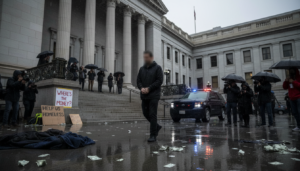
Homeless Man Breaks Down he Watches his Shelter Being Torn Ground Police
LOS ANGELES — On a crisp April morning in 2016, a homeless man stood helplessly as bulldozers reduced his makeshift shelter to rubble, tears streaming down his face as police officers looked on. The scene unfolded in a downtown alleyway, where the man, who declined to give his name, had cobbled together a tent from scraps of tarp and cardboard. It was just one of many such structures targeted in a city-wide sweep aimed at clearing encampments from public spaces. Witnesses described the moment as raw and emotional, with the man dropping to his knees, sobbing openly amid the chaos of machinery and flashing lights.
Authorities had arrived early that day, backed by a team of officers and city workers, to enforce a new ordinance cracking down on unauthorized homeless setups. The man’s shelter, tucked between two buildings, was seen as a hazard or eyesore, but to him, it represented a rare bit of stability in an otherwise unsteady life. As the demolition began, he pleaded with the workers to stop, his voice cracking with desperation. Police maintained a firm presence, keeping the crowd at bay and ensuring the operation went smoothly, though one officer later noted the man’s distress had made the job tougher than usual. It wasn’t the first time such actions had stirred up tension in the community, where homelessness had been on the rise for years.
The incident highlighted the ongoing clash between urban cleanup efforts and the human cost of displacement. Advocates for the homeless criticized the approach as heavy-handed, arguing that tearing down shelters without offering alternatives only pushed people further into the shadows. That afternoon, as debris was hauled away, the man wandered off with a small backpack, his future uncertain. While city officials defended the move as necessary for public safety, it left many wondering if there were better ways to address the root problems. In the end, it was a stark reminder of the daily struggles faced by those living on the margins, a moment that stuck with onlookers long after the dust settled.