Oregon Democrats Block ICE Notification for Felony Convicts
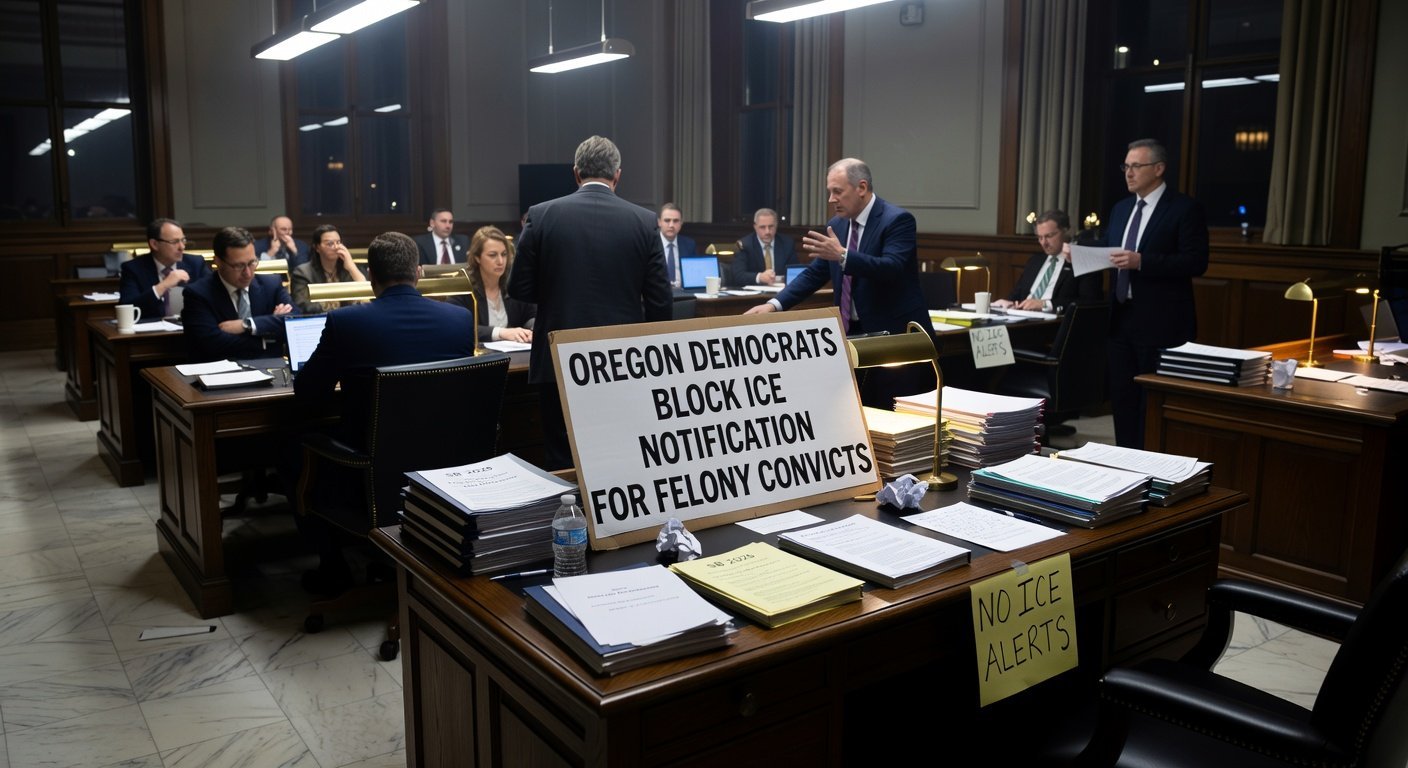
Oregon Democratic senators have unanimously blocked a bill that would have mandated state authorities to notify U.S. Immigration and Customs Enforcement (ICE) prior to the release of undocumented immigrants convicted of felonies involving named victims. This decision has ignited a firestorm of controversy, drawing sharp criticism from conservatives and highlighting ongoing tensions between state sanctuary policies and federal immigration enforcement.
The vote was spotlighted by the influential conservative X account Libs of TikTok, which posted a scathing tweet accusing Democrats of prioritizing politics over public safety. In the tweet, shared on March 5, 2026, the account stated: “BREAKING: Every single Oregon Democrat Senator just voted AGAINST informing ICE when an illegal alien convicted of a felony involving a named victim is being released from prison. Democrats just gave a massive middle finger to every victim of illegal alien crime.” This rhetoric echoes a broader sentiment of frustration among many Americans who believe that such policies endanger communities by allowing potentially dangerous individuals to evade deportation.

The legislation in question specifically targeted undocumented immigrants with serious criminal convictions, requiring notification to ICE at least 48 hours before their release from state custody. Proponents argued that this measure was essential for coordinating federal action and preventing reoffending. However, every Democratic senator in Oregon opposed it, aligning with the state’s entrenched sanctuary policies that date back to the 1980s. These policies, initially designed to protect vulnerable immigrants from aggressive federal enforcement, have evolved into a broader framework that limits state and local cooperation with ICE, even in cases involving violent crimes.
BREAKING: Every single Oregon Democrat Senator just voted AGAINST informing ICE when an illegal alien convicted of a felony involving a named victim is being released from prison.
Democrats just gave a massive middle finger to every victim of illegal alien crime.
Democrats hate… pic.twitter.com/wKCNwj0xds
— Libs of TikTok (@libsoftiktok) March 5, 2026
Critics of the decision contend that Oregon’s sanctuary stance creates significant risks for public safety, allowing convicted felons to slip through the cracks and potentially commit further offenses. For instance, federal data from the Department of Homeland Security indicates that some individuals deported for criminal activities have reentered the U.S. and reoffended, underscoring the potential dangers of non-cooperation. This vote is seen as a continuation of a troubling pattern in states like Oregon, where policies intended to foster inclusivity are perceived by opponents as shielding repeat offenders from accountability.
Conservative experts have been vocal in their condemnation of this move. Former ICE officials, such as Mark Morgan, have labeled such policies as “reckless and irresponsible,” arguing that they undermine national security. A recent report from the Heritage Foundation delves deeper into the issue, analyzing how states with sanctuary laws, including California and New York, have experienced elevated crime rates in certain areas due to limited collaboration with federal agencies. The report cites statistics showing that in jurisdictions with similar policies, there has been a measurable increase in crimes committed by undocumented individuals with prior convictions, amplifying the concerns now facing Oregon and potentially leading to more victims in the future.

Public reaction to the Libs of TikTok tweet and the subsequent vote has been swift and intense. Social media platforms erupted with outrage, as conservatives rallied under hashtags like #OregonCrime and #StopSanctuaryCities, sharing personal stories of victims affected by crimes committed by undocumented immigrants. For example, users highlighted cases from across the country where individuals with felony records were released without ICE notification, only to commit further violent acts. This digital backlash has not been limited to online spaces; in Oregon, local advocacy groups have organized rallies demanding accountability from state leaders, reflecting a growing grassroots movement against what they view as misguided policies.
Beyond immediate reactions, the long-term implications of this decision could be far-reaching. By refusing to notify ICE, Oregon may encourage other sanctuary states to double down on their positions, potentially weakening overall border security and immigration enforcement efforts at the national level. This could lead to increased tensions between state and federal governments, with the possibility of legal challenges or executive actions from Washington. Moreover, as the 2026 elections approach, Republicans are already leveraging this issue to criticize Democrats, framing it as evidence of a broader failure to prioritize American safety over partisan interests. Victims’ rights organizations are pushing for reforms, advocating for bipartisan measures that balance compassion for immigrants with the need to protect communities.
Expert analysis from immigration policy analysts further illuminates the complexities at play. Scholars like Jessica Vaughan from the Center for Immigration Studies have pointed out that while sanctuary policies aim to build trust within immigrant communities, they often fail to address the subset of individuals who pose genuine threats. In Oregon’s case, this vote might exacerbate existing challenges, such as overburdened local law enforcement and strained resources for tracking high-risk offenders. The potential for long-term increases in crime rates, as suggested by comparative studies of sanctuary versus non-sanctuary states, raises alarms about the unintended consequences of such decisions.
Adding to the national discourse, this event draws parallels to similar controversies in other states. For instance, in California, ongoing debates over sanctuary laws have led to high-profile cases where convicted criminals were released and later committed additional crimes, fueling calls for policy reevaluation. Oregon’s action could inspire a counter-movement, with lawmakers in states like Texas and Florida introducing tougher bills that mandate cooperation with ICE, potentially creating a patchwork of enforcement across the U.S. that complicates federal efforts and highlights the divisive nature of immigration reform.
As federal pushback looms, including possible increases in ICE operations within Oregon and congressional investigations into state compliance with federal law, the decision underscores a critical divide in American politics. Democrats’ stance may alienate moderate voters concerned about crime, while conservatives use it as a rallying point to advocate for stricter enforcement. In the end, this vote not only reflects a prioritization of ideology over safety but also ignites a necessary conversation about how to balance humanitarian concerns with the imperative to protect citizens.
The human toll of these policies cannot be overstated, as evidenced by stories from families who have lost loved ones to crimes committed by individuals who should have been deported. Moving forward, it is imperative for leaders to reconsider such approaches, ensuring that justice and public safety take precedence. Oregon’s Democrats may have scored a political point, but at what cost to the communities they are sworn to serve? This incident serves as a stark reminder that policies must evolve to address real-world risks, fostering an environment where law-abiding residents can live without fear.
In conclusion, the Oregon vote exemplifies a broader national debate on immigration and crime, with potential ramifications that extend far into the future. As more states grapple with these issues, the pressure for comprehensive reform will mount, urging policymakers to find common ground that upholds both compassion and security. Ultimately, safeguarding American citizens must remain the foremost priority, transcending partisan divides to prevent further tragedies.
Photo: RobThinks / Wikimedia Commons, CC BY-SA 4.0
Read more: Man Steals Flamingo In Las Vegas, Brings It Back To His Hotel Room