Outrage as State Worker Keys Teslas and Gets Slap on Wrist
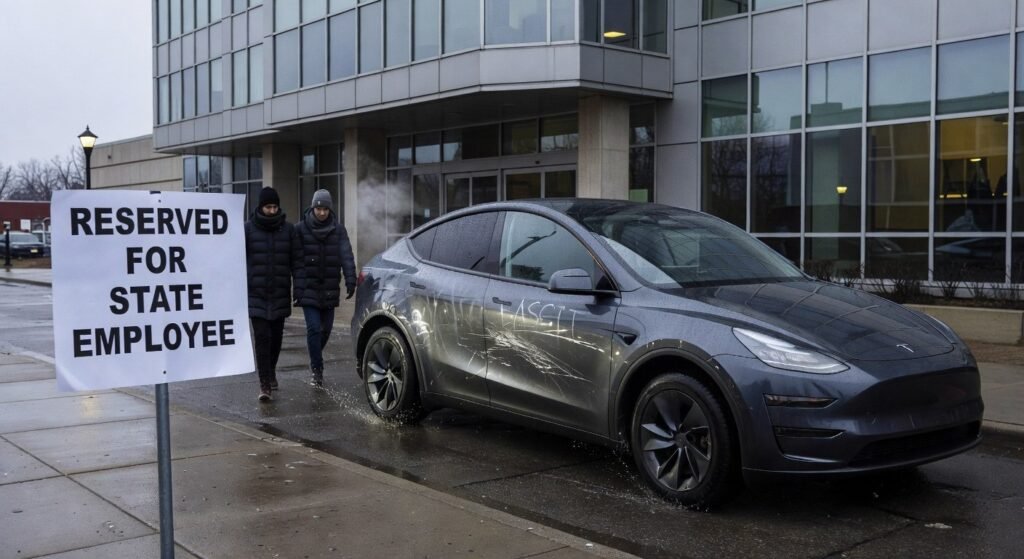
Minnesota state employee Dylan Bryan Adams was recently arrested for a series of deliberate acts of vandalism targeting Tesla vehicles, resulting in over $20,000 in damages. The incident occurred in a busy public parking lot in a Minneapolis suburb last year, where Adams allegedly used a key to scratch deep gashes across the doors, hoods, and side panels of at least five Tesla Model 3 and Model Y cars. Eyewitnesses reported seeing a man matching Adams’ description methodically approaching the vehicles and inflicting the damage before fleeing the scene. Law enforcement responded swiftly, reviewing security footage and gathering statements that led to Adams’ arrest within days. As an employee of the Minnesota Department of Transportation (MnDOT), which is responsible for maintaining infrastructure and promoting safe roadways, his involvement in such destructive behavior has raised serious questions about the accountability of public servants and the potential personal motivations behind his actions.
The targeted areas on the Teslas were not random; Adams focused on high-visibility and costly components, such as the sleek body panels that are signature to Tesla’s design, forcing owners to deal with extensive repairs that could take weeks or even months. Tesla’s service estimates pegged the total damage at over $20,000, covering not just the physical fixes but also potential downtime for the vehicles. Investigators have delved into possible motives, suggesting that Adams’ actions might stem from deep-seated grudges against electric vehicles (EVs) or their owners, perhaps fueled by ongoing national debates over environmental policies and the shift away from traditional gasoline-powered cars. Colleagues described Adams as generally quiet and unassuming, with no prior criminal record, which has led to speculation about underlying job-related stress or ideological conflicts. For instance, sources within MnDOT indicated that Adams had expressed reservations about the state’s aggressive push for EV infrastructure, hinting at a personal clash between his views and the agency’s priorities.

Minnesota has been at the forefront of the EV revolution, with state initiatives aimed at expanding charging stations, offering incentives for EV purchases, and integrating green transportation into public policy. The Department of Transportation has played a pivotal role in these efforts, investing millions in projects to reduce carbon emissions and promote sustainable mobility. However, this rapid transition has not been without controversy, as some residents and employees grapple with the economic and cultural shifts it entails. Experts in workplace dynamics, such as organizational psychologist Dr. Laura Chen, argue that public employees often face internal conflicts when their personal beliefs diverge from institutional goals. In Adams’ case, his outburst may represent a manifestation of bottled-up frustration over the state’s green agenda, illustrating how unresolved tensions in the workplace can escalate into harmful behaviors. This incident underscores the need for better support systems, like mandatory conflict resolution training, to prevent such escalations in the future.
Minnesota State employee Dylan Bryan Adams was arrested for keying a bunch of Teslas causing over $20,000 in damages.
His punishment?
A one day suspension.
What a joke pic.twitter.com/sMQmldAEXP
— Libs of TikTok (@libsoftiktok) March 5, 2026
Legally, Adams was charged with felony vandalism under Minnesota state law, which carries potential penalties including substantial fines, restitution to the victims, and even imprisonment. Despite these serious charges, his employer at MnDOT imposed only a one-day suspension, a decision that has ignited widespread outrage and debate over appropriate disciplinary measures for public officials. State regulations emphasize high ethical standards for government employees, yet this lenient response has been criticized as inadequate, potentially eroding public trust in the system. Professor Jane Ellis from the University of Minnesota Law School described the punishment as a significant misstep, arguing that it sends a message that property crimes by state workers might not be taken seriously, which could embolden others to act similarly. Legal analysts point out that such cases often require a balance between rehabilitation and deterrence, and this outcome appears to favor the former at the expense of the latter.
Human resources professionals and ethics experts have been vocal in condemning the light penalty, asserting that it trivializes the severity of property crimes and fails to address the broader implications for institutional integrity. Dr. Robert Hayes, an ethics consultant, emphasized that public employees are held to a higher standard because their actions reflect on government entities as a whole. He suggested that a more robust response, such as mandatory ethics retraining or extended leave, would better serve to prevent recidivism and restore confidence. Additionally, private companies like Tesla have responded aggressively, pursuing civil lawsuits against Adams for damages and potentially setting precedents for how corporations handle vandalism against their products. This contrast between public and private sector reactions highlights a growing disparity in accountability mechanisms, with some experts warning that it could lead to increased privatization of justice if government responses remain inconsistent.

Public reaction to the story has been intense, amplified by social media platforms where a tweet from Libs of TikTok detailing Adams’ arrest and suspension quickly went viral, amassing thousands of shares and comments. Tesla owners across the country shared their own experiences with vandalism, recounting the financial and emotional toll of such acts and calling for stricter enforcement of anti-vandalism laws. While the majority of responses condemned Adams’ behavior as senseless and criminal, a minority framed it as a form of protest against what they perceive as overzealous environmental policies. Local news outlets in Minnesota covered the uproar extensively, featuring interviews with affected vehicle owners who expressed frustration over the state’s handling of the matter and demanded greater transparency in disciplinary processes. This online discourse has spilled into broader conversations about EV adoption, with advocates arguing that incidents like this could deter potential buyers and hinder progress toward sustainability goals.
The long-term implications of this case extend beyond the individual perpetrator, potentially reshaping how public agencies approach employee misconduct and environmental policy enforcement. For instance, it could prompt revisions to workplace policies, including enhanced background checks, regular ethics workshops, and zero-tolerance policies for crimes committed by staff. On a societal level, the incident highlights the ongoing tensions between traditional automotive interests and the push for green technology, serving as a cautionary tale about the risks of unaddressed grievances. If similar events occur, they might inspire copycat vandalism or further polarize communities, emphasizing the need for dialogue and education to bridge divides. Moreover, Tesla and other EV manufacturers may advocate for improved parking lot security measures, such as surveillance upgrades or designated safe zones for electric vehicles, to protect their customers and assets.
As the legal proceedings continue, this scandal could influence broader reforms in public accountability and sustainable energy initiatives. Courts might establish new guidelines for restitution and rehabilitation in cases involving public employees, possibly requiring psychological evaluations or community service tied to environmental causes for offenders like Adams. Nationally, the episode draws attention to the importance of integrity in government roles during times of rapid technological change, urging policymakers to foster environments where differing opinions can be expressed without resorting to destruction. In the end, Adams’ case serves as a stark reminder of the vulnerabilities in our systems, with critics continuing to push for independent reviews of disciplinary actions to ensure that punishments align with the severity of crimes and uphold the values of transparency and justice in public service.
Screenshot from YouTube video, used under fair use for news commentary | Photo: Syced / Wikimedia Commons, CC0
Read more: North Carolina's New 'Abolitionist' Judge Sparks Outrage